5 min. read
- Articles and Resources
- >Personal Effectiveness
- >How Emotions Affect Decision-Making at Work
How Emotions Affect Decision-Making at Work
Most professionals think of themselves as rational decision-makers. In practice, emotions shape how information is interpreted, how risks are judged, and how quickly people move to action, especially under pressure. How emotions affect decision-making at work often remains unnoticed until the consequences appear, when decisions that felt logical lead to rework, conflict, or regret.
Emotions affect decision-making at work by shaping attention, risk perception, and speed of judgment, especially under pressure, often influencing choices before we are consciously aware of it.
Key Insights
- Emotions influence judgment long before people are consciously aware of it.
- Stress narrows attention and speeds decisions, often at the cost of quality.
- Different emotions push decisions in different directions.
- Self-awareness is a practical decision skill, not a personality trait.
- Clearer decisions under pressure can be learned and practiced.
Why workplace decisions are rarely as rational as they feel
Decision-making at work is not a purely analytical process. Research on decision-making and emotion summarized by the Harvard Kennedy School shows that emotions are embedded in choice itself, influencing what information people notice, how options are evaluated, and which outcomes feel acceptable in the moment.
In real workplaces, emotional decision-making rarely looks dramatic. It is more subtle. Common examples include over-indexing on risk after a public mistake, pushing decisions through to relieve tension, or delaying action to avoid discomfort. These patterns reflect how emotional cues quietly shape perception and judgment under everyday pressure.
How stress reshapes judgment, risk tolerance, and speed
Stress intensifies emotional influence. A 2024 integrative review published in Brain, Behavior, & Immunity – Health explains that stress alters cognitive processing in ways that directly affect decision-making. Under pressure, people rely more on mental shortcuts and less on deliberate evaluation.
Guidance from the Canadian Centre for Occupational Health and Safety describes stress as a response shaped by how demands are appraised relative to available resources. When demands feel high and control feels low, judgment narrows. In workplace terms, this often leads to rushed approvals, avoidance of difficult conversations, or decisions that prioritize short-term relief over longer-term outcomes.
Hot and cool decision-making under pressure
There is a distinction between hot and cool cognition. According to the National Academies Press, hot cognition is emotion-driven and reactive, whereas cool cognition is more deliberate and goal-oriented. Under pressure, people often slide toward hot thinking without noticing the shift.
This helps explain why decision quality often declines at the very moments when stakes are highest. For many professionals, this only becomes obvious in hindsight, after a tense discussion, a reactive email, or a decision that backfires. In structured exercises and role-play scenarios, the same dynamic often becomes visible as participants work through realistic situations. Research and applied decision-making literature consistently point to this effect. Naming the shift in the moment creates a pause that supports better judgment.

How emotional influence shapes everyday workplace decisions
In most organizations, emotional influence appears in small, repeated moments rather than major crises. A neutral response is interpreted as dismissal. A direct question is read as challenge. Silence is mistaken for agreement. Over time, these misread signals compound and decisions drift away from their original intent.
When a decision leads to a poor outcome, people tend to focus on the choice that was made (“That was the wrong call”) rather than how the decision was formed. In most cases, the more useful leverage point is earlier, when emotion first shapes perceptions and assumptions. Skills such as emotional awareness and regulation help people intervene before reactions harden into positions.
The DECIDE Under Pressure model
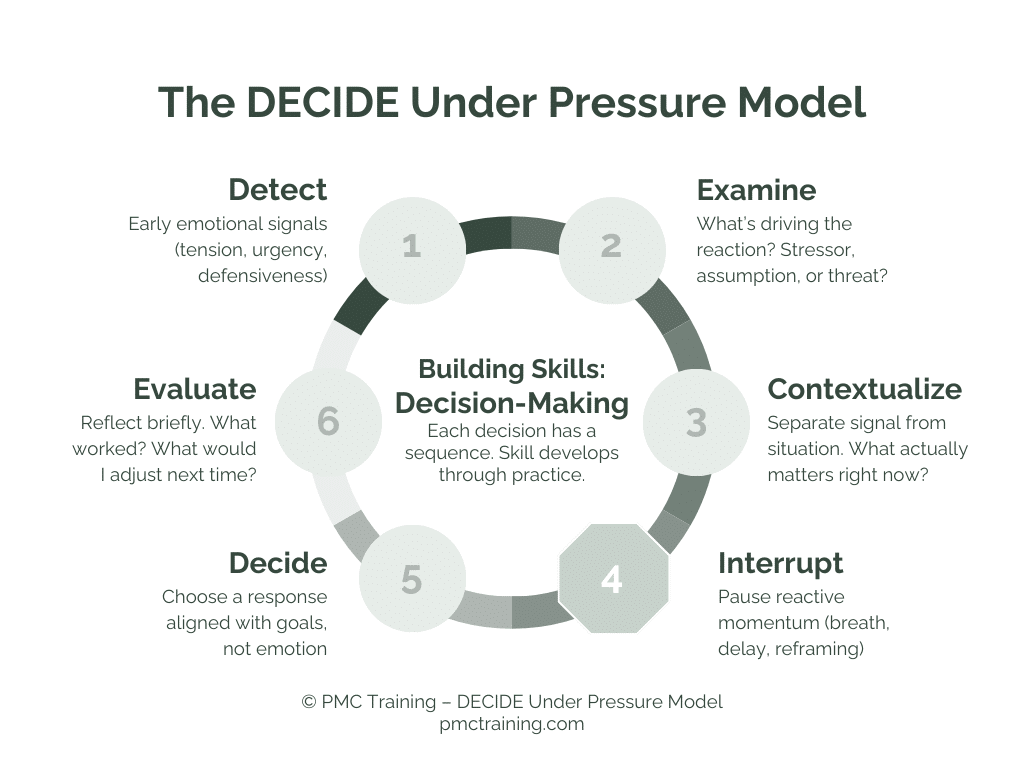
To make emotional influence visible and manageable, PMC Training uses the DECIDE Under Pressure model. It provides a practical lens for slowing reactive decisions and widening perspective when pressure is high.
DECIDE stands for Detect, Examine, Contextualize, Interrupt, Decide, and Evaluate. Rather than suppressing emotion, the model helps professionals notice emotional signals early and prevent them from quietly taking control. It is informed by research on stress and hot cognition and grounded in facilitation experience across sectors.
Using emotional intelligence to improve decision quality
Emotional intelligence becomes practical when it improves the quality of real decisions. A 2024 study published in PLOS ONE shows that how people appraise stress matters. Moderate, well-appraised stress can support performance, while poorly appraised stress undermines judgment.
When applied through structured approaches such as the DECIDE Under Pressure model, emotional intelligence skills help professionals pause, test assumptions, and choose responses aligned with their goals. In workshops, participants often report fewer reactive decisions and clearer follow-through once these habits are practiced consistently.
Building stronger decisions under pressure
If emotional influence on decision-making is left unexamined, even experienced professionals will repeat avoidable mistakes. The skills required to manage this influence are learnable and practical.
For professionals looking to strengthen self-awareness, regulate emotional responses, and apply decision frameworks under real pressure, Personal Effectiveness Through Emotional Intelligence (EQ1) provides structured practice grounded in workplace realities.